Here’s a thing I’ve been sitting with: the ski resort marketers I know who are best at their jobs — the ones whose guests actually feel a connection to the mountain — are almost never the ones drowning in their inboxes.
They’re the ones who somehow still have time to be present. To read the comments. To reply like a human. To ski on a powder morning and bring back a story worth telling.
That’s not an accident. And increasingly, it’s not luck either.

AI handles the tasks. You handle the mountain. That’s the whole point.
The Problem Nobody Talks About Out Loud
Most resort marketers got into this industry because they love mountains and the people who love them. The job, at its best, is mountain storytelling and community stewardship.
Then the week fills up. Email scheduling. Social posts. Ad variants. Conditions updates. Reports. Campaign calendars. CMS updates. Inbox triage. Resize this for Instagram. Reformat that for email. Generate this week’s report before the Tuesday meeting.
According to MMGY Origin and SAM Magazine’s 2024 Outlook on Resort Marketing survey, 56% of resort marketers reported a flat budget for FY2024 — and 69% came from resorts with 250,000 annual visits or fewer. These are lean teams. One or two people covering every channel, every season, every crisis.
And when teams get stretched that thin, the first things to go are always the most human things: thoughtful replies to individual guests, time spent reading what people are actually saying, being on the mountain to find real stories, personal follow-up after something goes wrong.
The data backs this up in a gnarly way. NSAA-linked analysis in SAM found that national guest satisfaction NPS dropped 8-9 points over two seasons compared to 2020-21. Large ski areas fell from a 67 to a 58. The Rocky Mountain region dropped from 79 to 67. These aren’t just crowding numbers. They’re emotional engagement numbers. Guests aren’t just frustrated with lift lines. They’re feeling less connected to the mountain.
What AI Actually Does (When Used Right)
Here’s the framing that matters: AI should automate the transaction, not the relationship.
The mechanical stuff — first-draft snow reports, caption variants, sentiment summaries, email scaffolding, FAQ clustering, weekly report generation — that’s what AI is genuinely good at. Not because it replaces judgment, but because those tasks don’t require judgment. They require pattern recognition and drafting speed.
When a resort marketer gets even 5-10 hours back per week, something changes. Not just in what they produce — in what they can notice. They have time to actually read the comments instead of counting them. They can reply personally to the regular who posts every storm cycle. They can ski a powder morning and come back with a real story instead of a recycled caption.
Salesforce’s customer research found that 73% of customers say companies treat them like an individual rather than a number — and 61% say AI advances make trust even more important, not less. People aren’t asking for less human contact. They’re asking for more genuine human contact, less buried under templated noise.
The Resorts Already Doing This Right
The 2025 NSAA Marketing Awards are worth studying for what they reveal about what actually resonates with guests. Deer Valley built a campaign using CRM personalization and evocative storytelling that drove higher click-through rates while cutting ad spend by 65%. Steamboat built around specific guest personas and delivered emotionally tailored content across demographics. Palisades Tahoe combined real-time operational updates with genuine storytelling and community engagement.
And then there’s Bridger Bowl. Nonprofit, community-owned, focused on “the best skiing experience at a reasonable cost.” Their marketing director, Erin O’Connor, put it simply: “We’re not trying to be something we’re not. We are who we are.” SKI Magazine described Bridger’s atmosphere as “radical friendliness.” Guests call it home. That identity doesn’t come from a better content calendar. It comes from people who are actually embedded in the culture and have enough bandwidth to stay embedded.
Jay Peak won NSAA recognition for “Pass the Jay” — a campaign built around community participation and emotional authenticity. Bogus Basin won for a campaign grounded in local pride: “The mountains are for memories. Not for profit.” Hatley Pointe built loyalty by sharing real challenges and behind-the-scenes progress — operational transparency turned into connection.
None of these campaigns were built on automation. But every one of them required marketers with enough space to actually think, observe, and create something worth caring about.
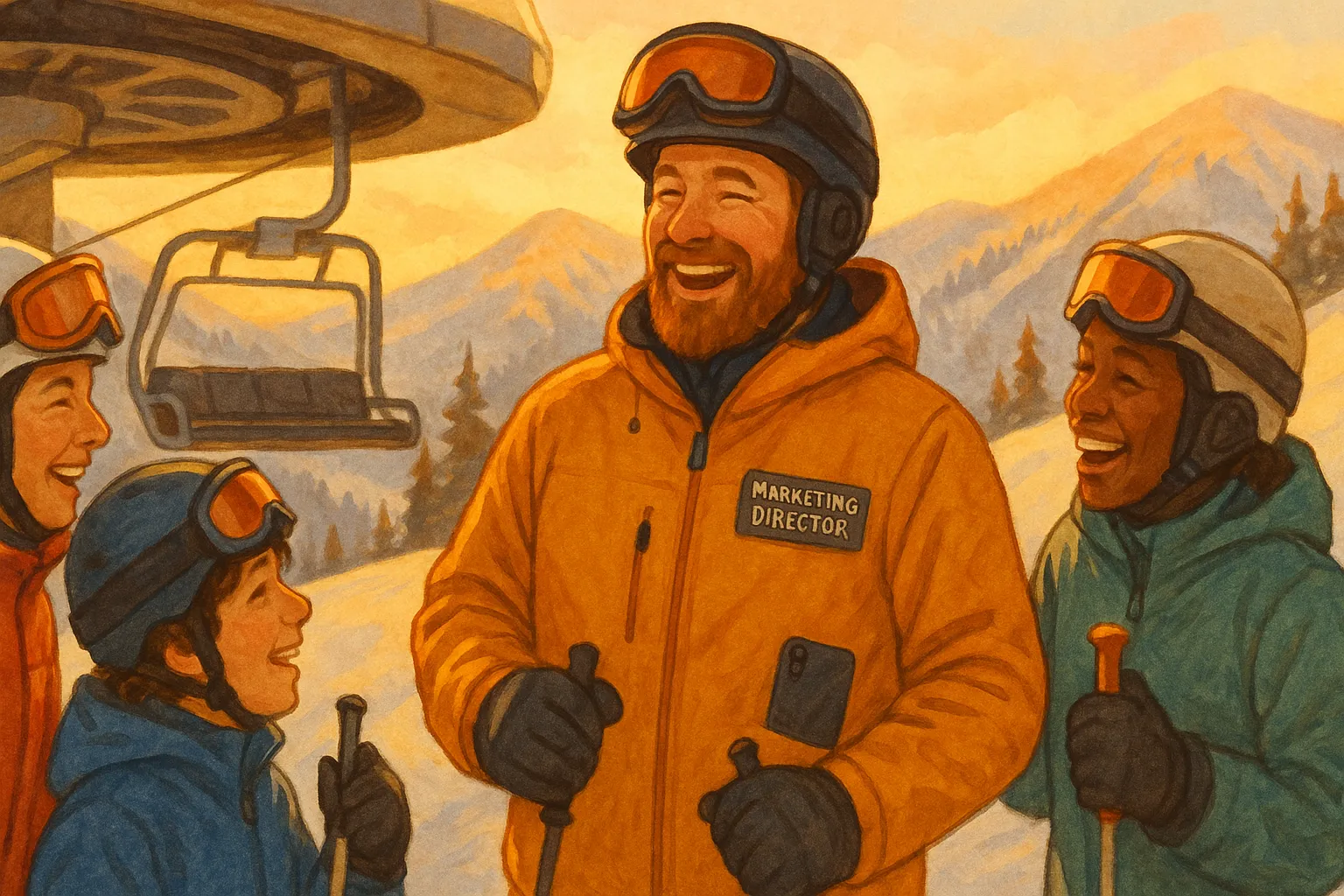
Guests remember whether your mountain felt like it cared. AI can’t do that — but it can free up the person who can.
The Division of Labor That Actually Works
Here’s how to think about splitting the work:
| Let AI Handle This | You Handle This |
|---|---|
| First drafts of snow reports + event blurbs | Final tone and local voice |
| Social caption variants by platform | Replies to regulars + DMs that need a human |
| Summarizing reviews, comments, survey data | Deciding what actually matters + escalating to ops |
| Clustering guest questions into FAQ themes | Guest recovery conversations + upset guest follow-up |
| Weekly reporting and metric summaries | On-mountain observation + story gathering |
| Draft responses to routine inbound questions | Knowing which guest deserves a real reply |
The rule of thumb: if the task is repetitive, pattern-based, or draftable — AI can help. If the task involves trust, identity, emotional nuance, or judgment — a human needs to own it.
The Insight Loop Nobody’s Using
The most underrated use of AI in resort marketing isn’t content generation. It’s surfacing what guests are actually saying.
AI can pull patterns from your Google reviews, Instagram comments, post-visit surveys, and DMs and surface them in a weekly brief: what people keep complaining about, what they keep praising, what questions keep showing up. That brief takes a human five minutes to read and act on — instead of three hours to compile manually.
That’s the loop: AI surfaces patterns → human notices what matters → human responds and acts → guest feels heard → loyalty strengthens. It’s a much better mental model than “AI writes our posts.”
The scarcest resource in ski resort marketing isn’t data. It’s attention. AI can’t replace the marketer who skis a powder morning, talks to the lifties, and comes back with a story worth telling. But it can make sure that marketer actually has a powder morning to ski.
Most resort marketers didn’t get into this industry because they love spreadsheets. They got in because they love mountains and the people who love them. The right AI stack doesn’t change that. It protects it.
What’s the one task eating your week right now that you wish you could get off your plate? Would love to know — that’s usually the best place to start.
Sources: MMGY Origin / SAM Magazine — Outlook on Resort Marketing (2024) | NSAA / SAM — Guest Satisfaction Analysis | NSAA Marketing Awards (2025) | Salesforce — State of the AI Connected Customer | Storm Skiing Journal | SlopeFillers
Want help building an AI workflow that puts your team back in front of guests instead of behind a screen? Book a free 20-min call →